The human digestive system is a complex group of organs that chemically and mechanically breaks down the food you eat so the nutrients can be used as energy for a humans cells, and expels waste, poop, from the body. It is also possible to simulate the digestive system and process with everyday items. The process is as follows:
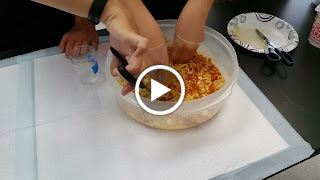
1. First food enters the body through the mouth where it is mechanically broken down by the molars and incisors, and the food is chemically broken down by the enzyme amylase. Amylase converts carbohydrates to glucose. This first step of digestion was represented by food getting mushed and cut by scissors and plastic cups. The digestive system adds amylase to your mouth through the salivary glands, and can be simulated simply by pouring in a cup of "Amylase"into the bowl (mouth).
 |
| Molars, Incisors, and Amylase, in mouth, breaking down food |
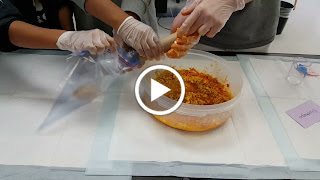
2. Next, the food travels down the esophagus to the stomach. This was modeled by dumping the food from the tub into a paper towel roll in a gallon plastic bag. Once the food is in the stomach it mechanically breaks down by being smashed by the stomach, which is a muscle, this was simulated by smashing the bag. The food is also digested chemically in the stomach where pepsin, lipase, and hydrochloric acid are added to the food to break down the fats and proteins into the food into absorbable nutrients.The hydrochloric acid was modeled by vinegar, and the enzymes pepsin and lipase were modeled with lemonade and soap.The bag was the chosen for a model of the stomach because it is flexible and is able to be contracted by the demonstrators' hand,
 |
| Pepsin, Lipase, and HCL |
 |
| Food moving down the esophagus from the mouth |
Food being mechanically and chemically digested
3. Next, the broken down food is pushed into the small intestine by means of the duodenum. In the small intestine, bile is added through the common bile duct. More pepsin, lipase, and amylase are added to further break down the carbohydrates, proteins, and fats. The nutrients from the broken down food are absorbed through the small intestine for use in the cells of the body. The small intestine was modeled by a pantyhose because like the small intestine it was able to let the fluid and nutrients flow through its walls while the waste stays contained inside.
 |
| Food being transferred from the stomach to the small intestine. |
 |
| Pepsin, lipase, amylase, and bile. |
 |
| Nutrients being absorbed through the intestine wall. |
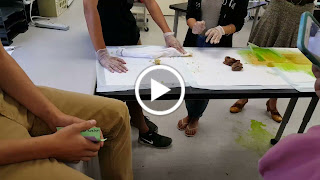
4. Now, the digested food flows from the small intestine into the large intestine which absorbs most of the liquid from the fecal matter.This was modeled by a thick men's sock because it could absorb all of the liquid from the fecal matter. Finally, the fecal matter becomes poop when muscles push it out of the anus. The anus is modeled by a small hole in the men's sock where the demonstrators push the poop out of.
 |
| Digested food traviling to the large intestine |
 |
| Large intestine absorbing liquid. |
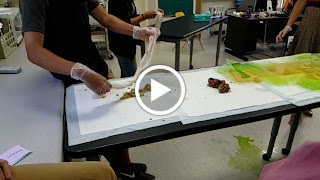 |
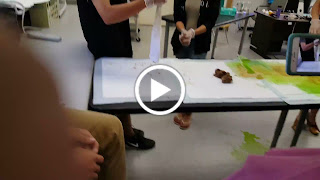
| Poop after coming out of the anus |
This is how humans make poop!
Works Cited
"Your Digestive System and How It Works." U.S National Library of Medicine. U.S. National Library of Medicine, Sept. 2013. Web. 21 Sept. 2016.








No comments:
Post a Comment